The Age 7 Orthodontic Rule: Why Early Monitoring Isn’t Just About Braces
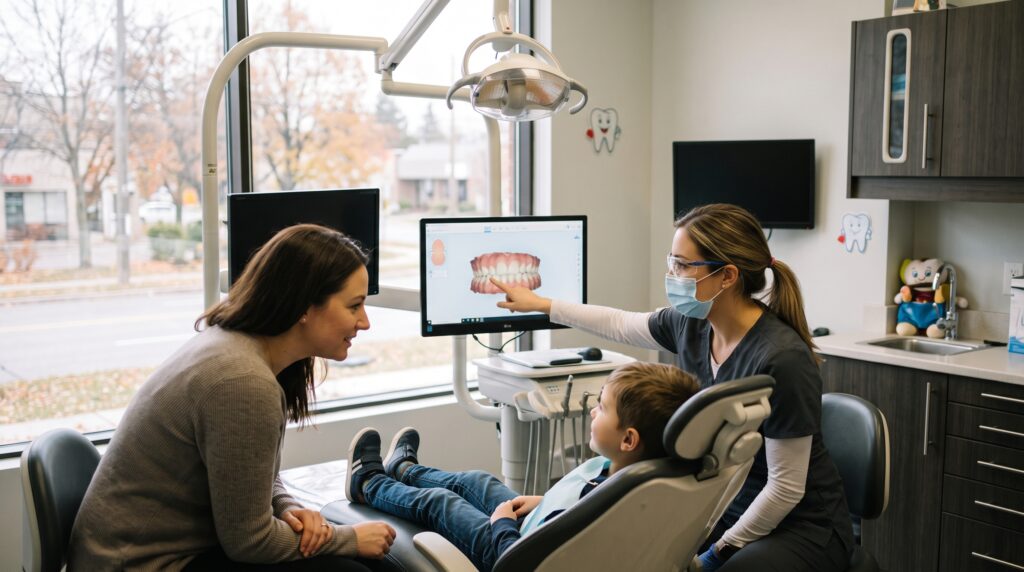
When parents think of orthodontic care, they usually imagine teenagers with metal brackets. However, both the Canadian Association of Orthodontists (CAO) and the American Association of Orthodontists (AAO) recommend that children have their first orthodontic evaluation no later than age 7.
This recommendation often raises eyebrows—at age seven, most children still have a mix of baby teeth and adult teeth. But an early consultation rarely means immediate braces. Instead, it marks the start of strategic orthodontic monitoring.
What Happens at Age 7?
By age seven, a child’s first permanent molars have typically erupted, establishing the back bite. This allows an orthodontic specialist to evaluate front-to-back and side-to-side tooth and jaw relationships.
Early evaluations help spot underlying issues before they become complex, including:
- Crossbites: When the upper teeth sit inside the lower teeth, causing uneven jaw growth or facial asymmetry.
- Severe Crowding: Inadequate space for permanent teeth to emerge properly.
- Impacted Teeth: Teeth (often upper canines) blocked from erupting into position.
- Habit-Induced Issues: Structural changes caused by prolonged thumb sucking or tongue thrusting.
Observation vs. Action
For the majority of seven-year-olds, the outcome of an initial consultation is simply observation. The orthodontist monitors jaw growth and tooth eruption every 6 to 12 months, determining the optimal window for treatment if needed.
For a small percentage of children, short-term Phase 1 interceptive treatment (such as a palatal expander or partial braces) can harness natural growth spurts. Correcting structural jaw issues early often prevents the need for permanent tooth extractions or surgical jaw alignment later in life.
Key Takeaway for Parents: An early evaluation doesn’t mean early braces—it provides a proactive roadmap for your child’s dental development.