Clear Aligners vs. Fixed Braces: How Digital Workflow Technology Is Changing the Choice
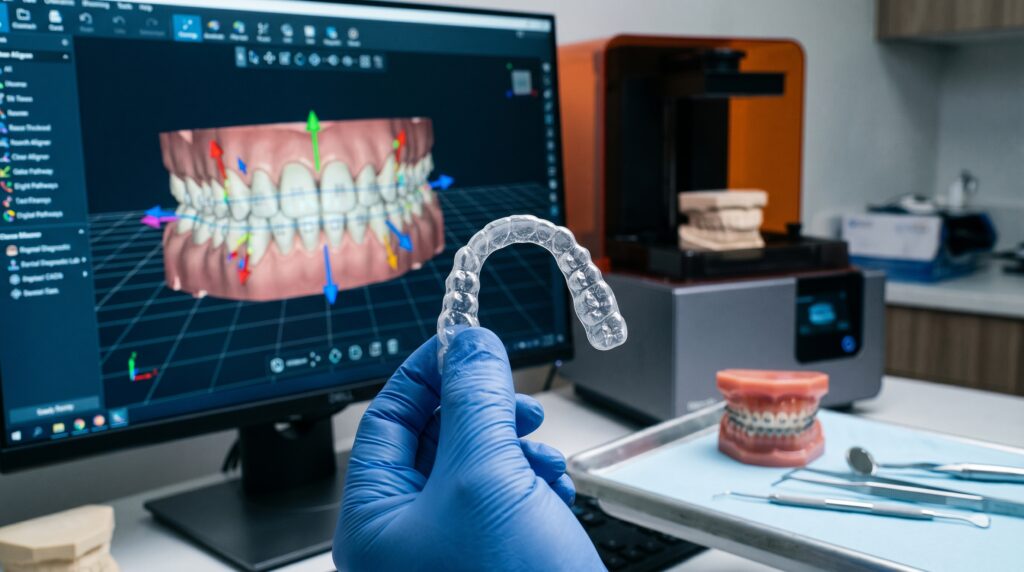
Adults now represent roughly 1 in 4 orthodontic patients across North America. A primary driver of this trend is the rapid advancement in clear aligner therapy and digital treatment planning.
However, choosing between clear aligners (like Invisalign® or Spark™) and traditional fixed braces is no longer just about aesthetics—it’s about biomechanics, lifestyle, and digital accuracy.
The Digital Revolution in Practice
Modern Canadian orthodontic practices have largely transitioned away from messy physical impression trays. Today’s diagnostic workflow includes:
- 3D Intraoral Scanning: High-speed optical scanners create an exact 3D digital model of the patient’s teeth within minutes.
- Computer-Aided Treatment Planning: Software allows specialists to map out tooth movements with sub-millimeter precision before treatment begins.
- 3D Printing: Customized aligners and indirect bonding trays for braces are printed directly from digital files, streamlining production and turnaround times.
Comparing the Options
| Feature | Clear Aligners | Traditional / Clear Braces |
|---|---|---|
| Aesthetics | Nearly invisible; clear removable trays. | Visible brackets (metal or ceramic option). |
| Removability | Removable for eating, drinking, brushing, and flossing. | Fixed; requires dedicated hygiene tools. |
| Compliance | Requires 20–22 hours of daily wear discipline. | Works 24/7 automatically; zero compliance friction. |
| Complex Cases | Highly effective for mild-to-moderate crowding/spacing. | Superior for severe jaw rotational issues or impactions. |
Making the Right Decision
While clear aligners offer unmatched convenience for adult professionals and disciplined teens, fixed braces remain the tool of choice for complex skeletal movements.
The decision comes down to a comprehensive examination by a certified orthodontic specialist, who evaluates not just how your smile looks, but how your jaw joints (TMJ) and bite function overall.